Thursday, August 20, 2009

New at "The Wall" - Ultronia Underwing

As soon as I saw this larger moth I knew it was something special. At least to me. The light has been attracting a host of smaller moths for the last couple weeks that I struggle to figure out and struggle harder to remember one night to the next. It s like attending that class reunion and recognizing the person but not quite remembering the name... Anyway the heat of the last week has been a welcome change from the cool damp summer of 2009. Activity has been increasing and I've found great enjoyment watching the Gray Tree Frog metamorphs climbing the "moth wall" to watch the show...


August 18th 2009 reached 91 degrees and the heat continued into the evening hours. I was enjoying the evening show between innings of the Red Sox - Blue jays Game (we won 10 - 9)
11:30 PM I was taking one last look at the wall for the evening when this handsome moth rolled in. I knew it was new to me and for the yard list... I first found it facing downward on the lower wall. It took a while to get him to open his hindwings for a photo but he finally managed to cooperate after about a dozen blurred shots... I'm ID'ing this one as Ultronia Underwing Catacola ultronia


Tough getting up at 5:00 AM for work when all this action is happening outside your window... I'm becoming a big fan of afternoon naps...


dave@dhsmall.net
http://dhsmall.blogspot.com/


Reblog this post [with Zemanta]


Sunday, August 9, 2009

Zebra Clubtail - What are you doing in my Pond?

Female Stylurus Scudderi Zebra Clubtail 8-8-2009 Athol Ma
The 30 X 40 foot backyard pond we constructed this spring is such a blast to explore it is almost beyond words.. Yesterday was no exception. Returning from a wonderful day of learning about bees and Pollinators with friends Joan Milam and Eric Eaton at the Mount Grace Land Conservation Trust Headquarters, I was showing off my little wet part of the world when a teneral dragonfly leaped into flight and immediately crash landed into the pool... The hapless insect was valiantly stroking its way across the pool as I ran for my handy insect net and I was able to let the dragonfly crawl up on the nets ring and bring it to safety...

In the excitement I hadn't processed the distinctive markings on the thorax or brown abdomen with yellow rings.. I was focused on the rescue... In the back of my mind I was hoping for some rare elusive emerald or other oddity...

When I finally had the little beast in hand it became obvious I was looking at a Gomphid, eyes apart and distinctive thoracic pattern. The ringed abdomen quickly brought me to the identification of Zebra Clubtail Stylurus scudderi. This species is currently listed and protected by the Ma Natural Heritage and Endangered Species Program. I called Friend and Athol Resident Lynn Harper who is the Heritage Odonate person and she came right over and viewed our drying out specimen... The record will be included in the Heritage database and be just another piece in the puzzle of as we unravel the life histories of these insects.
In Blair Nikula's fine field guide to Dragonflies and Damselflies of Massachusetts he describes scudderi habitat as: "Sand bottomed streams and small rivers with riffles". This is hardly a description of our little pool.
We are uphill (more than 2500 feet) from of a stream which has a potential habitat for this species but I've not found it there as yet... I may look this afternoon. The elevation of our home at 885 feet does bring Hill-topping behavior as a potential answer to my question...
No matter how it got here we are happy to add this species to our growing yard list.

I wonder what we'll discover today?


dave@dhsmall.net
http://dhsmall.blogspot.com/

Friday, August 7, 2009

Moths know what date it is?

The more I observe nature the more questions I have. Last Summer I started watching the moths attracted to our Mercury Vapor light (which I only turn on when I plan to monitor Moths)
Well as life would have it I turn on my "Moth Light" almost every night I'm home. It has been an enlightening education into the night world.

Now it isn't unusual for Shelley and I on most evenings to grab a flashlight checking out the "Light" and then head out to patrol the flower beds around the yard just before we turn the Moth light off for the night and head to bed... Its amazing all the activity we have been missing in our diurnal world... If we could rid ourselves of our day jobs we could happily stay up even later...

The Moths pictured above are members of one of my favorite groups. Haploa's are medium sized striking moths with lots if individual variability within species... But what are the chances that the species emerges and finds our house on exactly the same date 2 years in a row?

Reading Ted Sargent's "Legion's of the Night" I found his dates for the Ilia Underwing Catacola ilia to correspond well with my discovery of this species at Quabbin... It was a very tight window of a week or so that Professor Sargent had recorded the species.

But this summer is very different than last. We've all complained about the rainy cool weather. The lack of butterflies and river dragonflies in June and July... But here right on schedule is Haploa clymene...

Maybe the world will OK after all

dave@dhsmall.net
http://dhsmall.blogspot.com/

Reblog this post [with Zemanta]

Thursday, August 6, 2009

Gray Tree Frogs metamorphs in the yard


After having constructed what I had thought would be a vernal pool in the yard this spring. We have been delighted with the constant entertainment it has brought us and the increase in our bio-diversity is beyond all our expectations...

American Toads Bufo americanus Green Frogs Rana clamitans and Gray Tree Frogs Hyla versicolor have been seranading us over the last several months. Tadpoles soon filled the pool joined by various Hemiptera like Backswimmers, Water Boatman and Water Striders. Odonates including Common Whitetails Libellula lydia, Twelve-spotted Skimmers Libellula pulchella were soon joined by eastern Forktails Ishnura verticalis, Fragile Forktails Ishnura posita. and even Sedge Sprites Nahelana irene graced the nearby flower beds.

But life in the wild is about predators and prey a constant parade of winner and losers in the game of life... The other morning the dynamic shifted slightly in favor of the prey items of the frogs as a Great-blue Heron arrived just after dawn. Undaunted by my approach for a photograph the heron gobbled up many tadpoles and young frogs as I watched.
The pond still has a lot of tadpoles left and the miniature lime green Gray Tree Frogs are scattered throughout the yard. I can rest assured that the best adapted (and lucky) of our young animals have survived the Herons presence... At least for today..


dave@dhsmall.net
http://dhsmall.blogspot.com/

Reblog this post [with Zemanta]

Sunday, August 2, 2009

Dragonfly Society of America - Northeast Meeting

One of the great things about our naturalist hobby is the wonderful people we meet as we pursues the wild creatures that peak our interest. This past week (July 31 to August 2nd) The Dragonfly Society of America - Northeast Meeting was held in Southeastern New Hampshire hosted my New Hampshire Audubon's Senior Scientist Pam Hunt. Friday morning field trips we curtailed by Thunderstorms the seemingly usual rain events of this wet and cold summer... Saturday broke with bright sunshine and about 60 dragonfly enthusiasts gathered at the Massabesic Audubon Center in Auburn New Hampshire. Hal White presented an engaging talk on the lesser known female entomologists who pioneered the study of Odonata in the Northeast. And our fearless leaders outlined potential sites to be visited during the day.

Now a little about the dragonflies. Pam was interested in filling the species lists for all New Hampshire towns so the group had a very useful purpose for the weekend. Pam was not disappointed in the outcome as the group scattered to the selected haunts. In all of these gatherings individuals are always hoping to discover new species for their personal life list and this event was very successful in that regard for myself. I was able to add 2 species to my New England list which is a pretty good accomplishment...

One new Species for me was the Scarlet Bluet (Enallagma pictum) found at Norton Pond in Raymond NH. Several pairs were seen ovipositing in the lily pad covered pond edge. Another of my favorite damselflies the Lilypad Forktail (Ischnura kellicotti) were observed perched on the abundant lilypads.

A fine picnic BBQ was organized Saturday Evening at the Kingston State Park and most organizations would have called it an evening but the crepuscular habits of many of the Darners and Emeralds found the net toting enthusiasts gathered at a local dog park in Kingston. The abundant mosquito's provided plenty of food for the dragonflies while we kept the mosquitoes well fed as well. Almost immediately after exiting the truck I needed my second life bug of the day a female Coppery Emerald (Somatochlora georgiana) This individual was donated to Ed Lam and may grace the pages of his Petersen Field Guide to Dragonflies which should hit the shelves in 2011...


So my thanks go out to Pam Hunt, Brian Pfiefer, Nick Donnelly, Nancy Rideout and all the members of the DSA who made this event another to remember.


Reblog this post [with Zemanta]

Wednesday, July 29, 2009

Night meetings aren't all Bad

My position at the Quabbin requires attendance at numerous night meetings and this Monday was no exception. Two hours in a crowed room, swatting mosquitoes, drawn by the exhaling crowd, and listening to the emotionally charged conversation. Lightning flashed in the night sky over Quabbin Reservoir as the crowd dissipated. Jonathan Yeo and I exited out the rear door locking up the office for the night when a large moth flashed from the breezeway.

Ilia Underwing Catacola ilia (8801) Underwings are a wonderful group of moths whose cryptic coloration keeps them well hidden from predators until the flash of the colorful under wing pattern startles the would be predator allowing a hasty escape. I first heard about them in the 1970's at Focus Outdoors at UMass where the renowned entomologist Ted Sargent talked of baiting moths with sugar and stale beer (Dad's beer was never safe again). Underwings were Ted's favorite; secretive and not usually attracted to lights making the development of special baits a kind of competition to find the secret ingredients that will fool these mysterious moths into view. Ted Sargent was also fascinated by the English names given species in this group of moths including the Sweetheart, Darling, Once-married, Mother, and the Penitent.

I don't see these beauties very often and this Ilia Underwing was the first I've been able to photograph in recent times. A great way to end an evening

Reblog this post [with Zemanta]

Sunday, July 12, 2009

Butterflies in short Supply

The Athol Bird and Nature Club used to take the summers off as birds were busy with nesting activities and members headed off for sunny beaches or focused on the home garden. The rising popularity of insect watching as led to a plethora of summer workshops and local trips in search of Butterflies, Dragonflies and other interesting members of the smaller world.

Saturday was one of those workshops. A dozen members and new friends joined Susan Heinricher and I at the Millers River Environmental Center for an overview of butterfly identification and then we were off to a local milkweed filled field for what I had hoped would be some great viewing of our local butterflies.

The flowers were abundant, the butterflies were not. The list included Monarch, Viceroy, Tiger Swallowtail, Great Spangled Fritillary, Common Ringlet, Summer Azure, Silver-spotted Skipper, Delaware Skipper and Little Glassywing. But instead of dozens of each species we only encountered about 20 individual butterflies and those we really had to work for, Perhaps the months of rain and wet weather has stressed our local populations. The best thing about insects if their ability to rebound, Able to lay hundreds of eggs at a time a bad season can be quickly
made up when conditions improve.

A subset of the group not saying "Uncle" traveled to my old stomping grounds of Tully Lake. Sharing the wet spillway meadows with the Disc Golf enthusiasts we quickly found American Copper and dozens of our target species the Bog Copper.
Aphrodite and Silver-bordered Fritillary were added to the days list, but as the group made its way along this wet open meadow a shift to Odonates began to emerge, The Variable Dancer Argia fumipenis, Slender Bluet Enallagma traviatum Calico Pennant Celithemis elisa, Halloween Pennant Celithemis eponia, Common Green Darner Anax junius, Spangled Skimmer Libellula cyanea, and dozens of my favorite little dragonfly the Elfin Skimmer Nanothemis bella

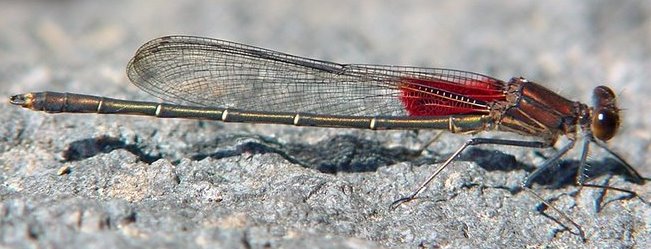
The real star of the show for me were several Eastern Red Damsels Amphiagrion saucium.
These diminutive damselflys have escaped detection locally for both Lula Field and I. Our friend Earle Baldwin has claimed finding them at two local locations (I guess now I'll have to concede and quit giving him grief) At any rate the Odonates saved the day and we wound up with a respectable list of these wonderful creatures...

Today we are off to the Ware River Watershed in Central Mass. This relatively unkown 24,000 acre area is part of the DCR Division of Water Suppy Protection's Quabbin Region. Skies are clearing after yet another rainy night... Who knows what will catch our eye today... Stay Tuned


Monday, July 6, 2009

4th of July Butterfly Counts


Finally a sunny weekend and just in time for the NABA 4th of July Butterfly Counts. I had the pleasure of attending 2 counts this weekend. The first North Worcester County Count was organized by Carl Kamp and the Wachusett Meadows gang with a Great after count BBQ by the Walker Family. This was a nice day for my wife Shelley and I to spend some quality time away from the garden chores bouncing around some interesting habitats and having fun... The second was the Eastern Franklin County count organized by Mark Fairbrother centered around Turners falls. I had the pleasure of the Company of my new friend Eric Eaton who is here for a few months from Tuscon.

Both counts were a lot of fun and a great chance to hang out with friends from both east and west of our Athol home base. Butterfly diversity and number of individuals on both counts were low. This perhaps due to the recent monsoons frustrating entomology buffs for weeks... But as always a day in the field brings interesting sightings and experiences. Sunday Eric and I found this interesting coupling of a Little Glassywing with a European Skipper... Will we return next year to this field to find European Glassywings?
There were many highlights for the day including a Spadderdock Darner Aeschna muttata which we stumbled upon as we exited a particularly rich patch of overgrown field near the Connecticut River in Northfield. Eric and I exchanged our enthusiasm and knowledge of the various insects we came across making for a fun and interesting day... Between us the insects didn't have a chance to escape our constantly clicking cameras.
I hope the folks conducting other counts over the weekend and the big Waldon Pond Bioblitz had as much fun as we did enjoying the first sunny weekend in a long time and our beloved invertebrates...


Posted by Picasa

Saturday, June 27, 2009

There Here! Moths arrive for weekend

7757 Antherea polyphemus Polyphemus


Friday nights are often a time for layed back relaxation from the week's hectic pace. I spent the beginning of the week at UMass attending the International Urban Wildlife Conference Congratulations to Stephan DeStephano and his team for a near flawless conference with great speakers, good food, and lots of old and new friends... I've been turning on my Moth attracting light for a few hours most nights to sample what is flying. Tonight after all the evenings of rain things are popping...

Polyphemus and Luna Moths were the Main event but dozens of other wonderfully patterned moths, Mayflies, beetles and Crane Flies dotted the sheet as the evening progressed.
I reflect back at the "Moth Ball" and the hard work our human visitors took to get to our 65 species for the night... I'm certain tonight we could easily eclipse that night's species count...

It will take some time for me to check out the ID of many of tonight's lepidopteran guests but a wonderful night it is and happy to be able to provide some habitat for these species and will turn my light off before dawn and chase my evening visitors away before the House Wrens, Chipping Sparrows and Blue Jays make the morning search of the "Moth Wall"


Thursday, June 18, 2009

Blogging opening Day

I'm trying this after reading Eric Eaton's Blog after his visit here the other night for an evening of Mothing dubbed the "Moth Ball" by our merry group of naturalists. Eric's Blog can be found at: http://bugeric.blogspot.com/